

There is something quite extraordinary about knowing what you want! And, when I’m working with my clients, it is imperative that I know that they know what they want. After all, I’m helping them to get there.
It’s interesting to me that when I help my supervisees or students with some of their client work how sketchy they can be on what their client wants. I was assisting someone the other day; she was asking me the standard “what NLP processes should I use with this person” question. Her client was very depressed, withdrawn from life and stuck. My first question to her was: “What is her desired state?”. In my opinion, there is no use doing anything with anyone unless I know where they are going. Her answer “she wants to be a professional dancer”. OK – I don’t know about you, but if my client is depressed their desired state is not to be a dancer. That might be the long-term goal, but not the desired state for right here and right now.
The question for the client becomes “what can I help you with right now?”  Call this an immediate intention, a desired state or even as Dr. Michael Hall calls it in Meta Coaching – a Key Performance Indicator (KPI). Whatever you call it, it is imperative to know what specifically you can help with right now. Even with yourself. Sure, you might want to be a professional dancer (or coach, or doctor, or mother, or husband), but can you be that tomorrow upon waking up? If not – its too far away.
If you learned NLP from Laureli or myself you will recall the below image – The NLP Formula.
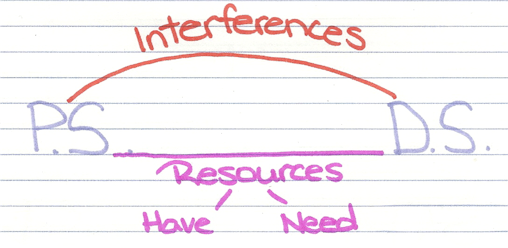 When using NLP as a change or progression tool with yourself or others, there are four key factors to look at:
1. Present State: Where are you now. This could also be called the problem state. This is where you get to complain, be negative, talk about what is wrong, notice what isn’t going right and be human!
2. Desired State: What you want now. Here we are looking at what specifically you want help with now. This should be in correlation with the PS – possibly the opposite of the PS sometimes. Remember also, we’re interested in what you WANT not what you DON’T WANT.
3. Interferences: What might be holding you back? What is interfering in your life that is stopping your Desired State from being your PS. If nothing – then just get on with it! Yet, there might be some unresolved emotions, patterns of thought or behaviour, other people, etc. It is these interferences that you will apply some of the NLP techniques to in order to change or clear the interferences.
4. Resources: Resources are attitudes, attributes, skills, things, etc. that you either have or need that will help you to get to your desired state. It’s important to understand these resources because they help us to build a strong foundation which will support changes and transformations of the interferences. We can use the resources you (or your client) has and we can add resources that will help.
While I think its important in the scheme of life to know future goals and longer term desired states, when applying NLP it is the now we want to know more about.
What specifically do you want now?
Hey Heidi. I totally agree. As a professional NLPer of 5 years now, I have realised how important it is to have wider bigger picture goals AND to help your client build a bridge as to how to get there. And it starts with now. One of the key influences for me for doing this in the most effective way for clients is Lynn Timpany’s Building Outcome Bridges process. She is my supervisor and has been doing one on one with folk for nearly 15 years and is a very significant influence on the NLP world in NZ.